
If you’ve ever wished your homeschool morning time felt a little more peaceful, a smidge less chaotic, and a lot easier to actually follow through on, I’m so excited to show you the new Cycle 3 Morning Time Guide.
(Okay, I confess… if your house is anything like mine, I can’t really promise less chaos. But it can be joyfully productive & organized chaos!)
This guide was created to help families gather together around Scripture, prayer, music, memory work, poetry, picture books, art, history, science, and read-alouds without needing to plan every detail from scratch.
That’s right – it covers every subject except grade level specific math & phonics/ reading/ spelling/ handwriting skills.
It is meant to be rich, but not rigid. Beautiful, but not fussy. Full, but not overwhelming.
Some days you may use the full plan. Other days you may simply play the memory songs over breakfast, pray together, and read one chapter aloud. It’s extremely flexible and no one is keeping score. So you get to make it work for you!
The goal is not to recreate someone else’s exact homeschool morning. The goal is to give you a simple rhythm you can return to again and again.
What Is Included in the Cycle 3 Morning Time Guide?
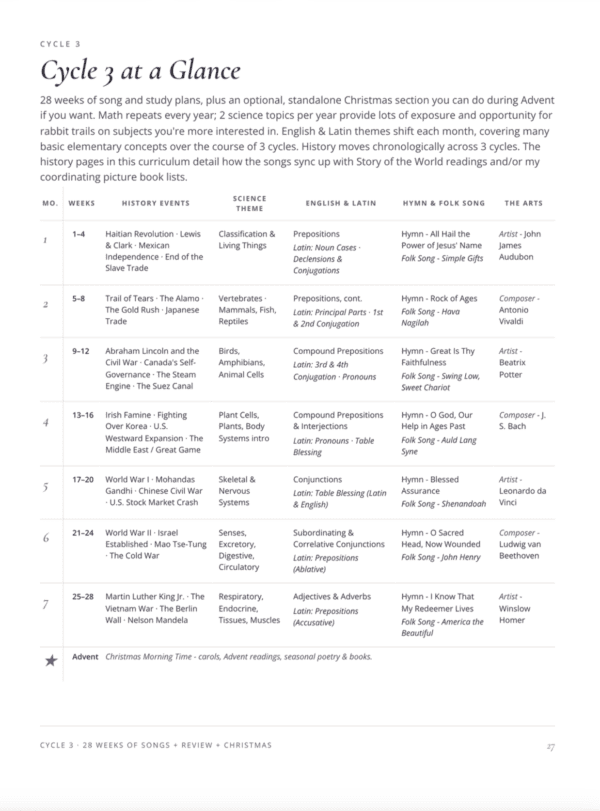
The Cycle 3 Morning Time Guide includes 28 weeks of plans, organized to coordinate with your Cycle 3 Musical Memory work. The plans are designed to be spread across 7 months, with flexibility for breaks, lighter weeks, and the real-life rhythm of your school year.
Advent plans are planned separately for the Christmas season and will hopefully be available this November!
Inside the guide, you’ll find:
- A suggested daily morning time rhythm
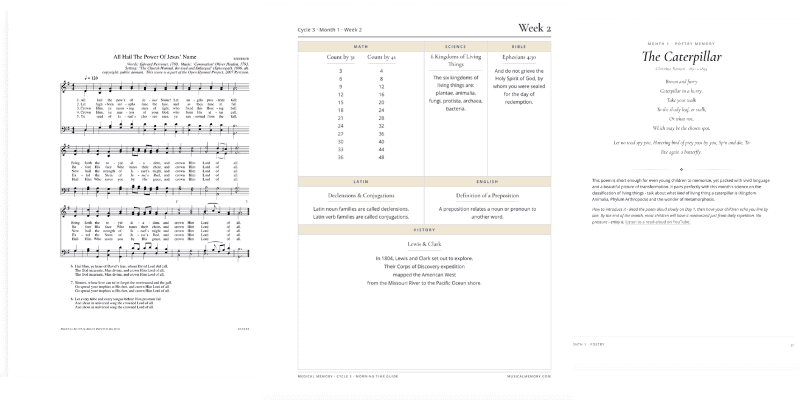
- Weekly plans that accompany the Musical Memory Cycle 3 Songs
- History – 1800s-1900s readings from Story of the World that align with the songs, picture books, timeline notebooking, map prompts
- A gentle 4-day History/ Art/ Science loop
- Very simple science journal prompts & activities
- Bible and prayer prompts
- Hymns & Folk Songs – sheet music, lyrics, and links to playlists for the year!
- Picture book “buffets” for each month – suggested books that go along with the song topics
- Artist and composer study
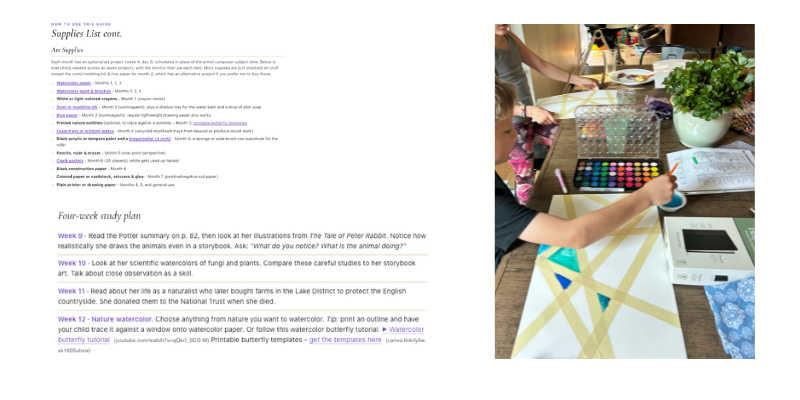
- Monthly art projects – mostly uses simple supplies all listed up front; links to tutorials
- Supplemental video and music links
- Read-aloud suggestions
- A printable student packet for kids to follow along
- All Musical Memory song lyrics
The Musical Memory songs can either be accessed in the app (annual fee is cheaper than monthly) OR purchased from my online shop.
A Simple Daily Morning Time Rhythm
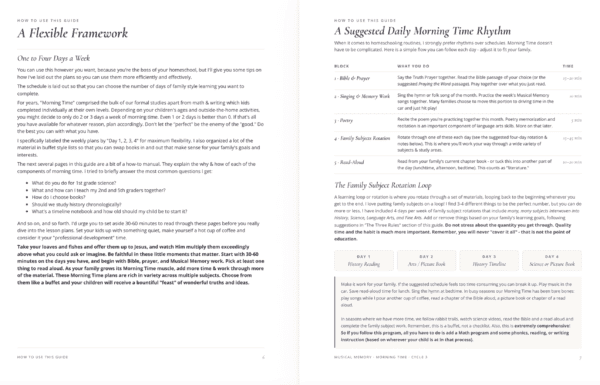
One of the most helpful parts of the guide is the suggested daily rhythm. Instead of wondering what to do first or how to fit everything in, you can open the guide and follow a simple flow.
A typical morning time might include:
- Bible and prayer
- Hymn or folk song
- Musical Memory songs
- Poetry
- One rotating subject with a reading, video, science activity, picture study, map or timeline prompt, etc.
- Read-aloud time
But the guide is also intentionally flexible. If morning time does not work as one neat block in your house, you can spread the pieces throughout the day. Morning Time could JUST consist of subject coordinated read alouds & prayer. Musical Memory & hymn/ folk song playlists can happen in the car. Poetry can happen at lunch. Read-alouds can happen before bed.
This is meant to serve your homeschool and consolidate family subjects, not boss you around.
Weekly Plans That Coordinate with Cycle 3 Memory Work
Each week includes a clear plan that coordinates with your Cycle 3 memory work songs. The weekly pages help you know what to review, what to read, what to sing, and what to enjoy together.
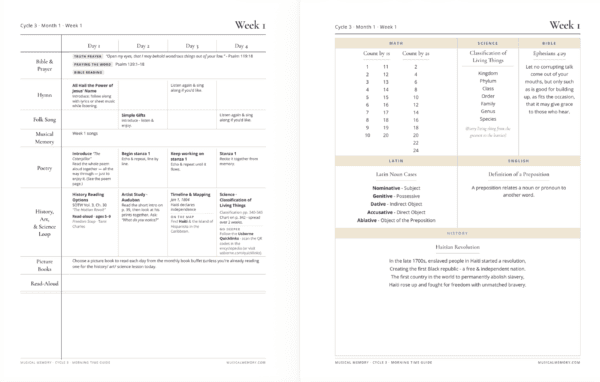
The plans are intentionally full so you have plenty to choose from, even if you repeat it the next time you hit Cycle 3 with your kids in 3 years. But you do not have to do every single thing. You can stretch a week out longer, skip what does not fit, or linger over a book, song, poem, or art lesson your children especially love.
The 4-Day Rotation
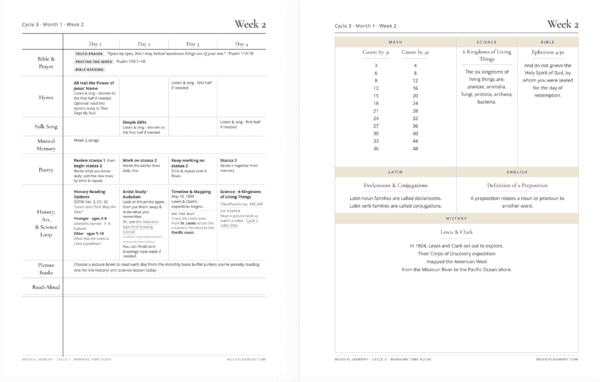
Instead of trying to cover every subject every day, the guide uses a 4-day rotation. This gives you a realistic way to include history readings, fine arts, picture books, timeline and map work, and science without making morning time feel crowded.
I promise THIS IS ENOUGH.
If your family only does morning time two or three days a week, you can still use the rotation. Just move through the days at your own pace, skip a couple things, or chunk days together and spend a little more time on it.
Bible, Prayer, Hymns, Folk Songs, and Poetry
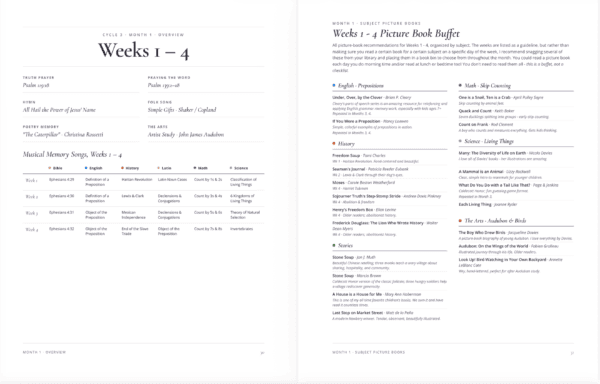
Each month includes Scripture to pray and recite together, along with hymns, folk songs, and poetry selections.
The goal is for children to grow up with beautiful words and music tucked deep in their hearts. Lyrics, sheet music, and poems are included so you are not hunting everything down on your own.
The guide also includes playlist links for the selected hymns and folk songs on Spotify and YouTube.
Picture Book Buffets
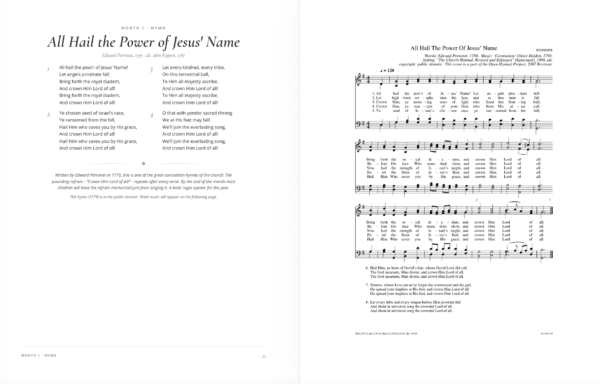
Each month includes a curated picture book list that coordinates with the topics you are studying in history, science, math, English, and fine arts.
I like to think of these as picture book buffets. You do not need to read every book on the list this time around. Choose from what your library has, what you already own, or what you can find secondhand. The list gives you options.
TIP – When I have time, I love browsing the nonfiction books at the library that are nearby the call number for a book from the list. It’s a great way to find other books on the same topic. Same for fiction picture book authors. 😀
Artist and Composer Study
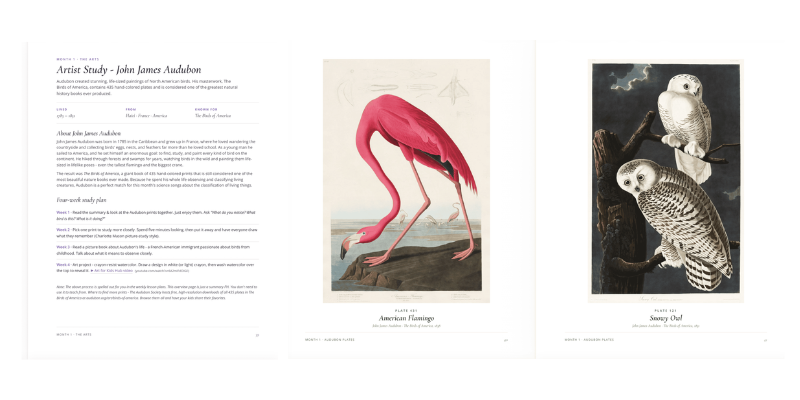
The guide alternates between artist study and composer study every other month. Artist prints and short biographies are included in the monthly plans, making this part simple to add even if fine arts tends to be the thing that gets pushed aside. Little tidbits about classical music and links to specific famous classical songs are also included.
Monthly Art Projects
Once a month, the plans include time for a hands-on art project instead of a regular artist/ composer lesson. The guide links to step-by-step tutorials and includes supply lists so you can prepare without having to invent a project on your own.
Some months include two project options, especially when it makes sense to offer one version for younger children and another for older students.
Supplemental Links and Videos
All the songs, videos, tutorials, and supplemental links mentioned in the guide are organized for you. If you are using the digital copy, you can click directly from the guide. You can also use the Cycle 3 links page on the Musical Memory website.
This makes the guide much more open-and-go. You are not searching for the right video while your children slowly disappear into the couch cushions.
Read-Aloud Suggestions
The guide also includes family read-aloud suggestions for the year. These are meant to support the atmosphere of your homeschool and give your family shared stories to enjoy together.
Read-aloud time can be part of your morning time block, or it can move somewhere else in the day. Do what works.
Student Packet
For older children who want their own morning time folder or binder, the guide includes a printable student packet. This gives them pages to follow along with and keeps everything conveniently gathered in one place.
Who Is This For?
The Cycle 3 Morning Time Guide was designed for homeschool families learning with children across multiple ages. It works especially well for ages 4–12, but younger siblings can listen in and older siblings could participate in the prayer, Bible, hymns and folk songs before being excused to work on their more rigorous independent work.
It is a good fit if you want:
- A ready-made morning time plan for K-5
- A gentle way to include beauty subjects
- A plan that coordinates with Cycle 3 memory work
- More structure without piecing together multiple expensive & overwhelming curriculums
- A family style learning rhythm that covers a broad & rich “feast” of ideas but can flex with real life
How to Use It
Print the guide, open to week 1, and begin with what fits your day.
That’s really it.
You can use the full plan four days a week, or you can choose a few pieces and rotate through them slowly. You can complete the 28 weeks during your school year, stretch them into summer, or pause for breaks whenever you need to.
The guide gives you a path, but you are still free to walk it at your family’s pace.
I’m currently accepting applications for people who want to join the pilot testing group for this curriculum. Apply here.