
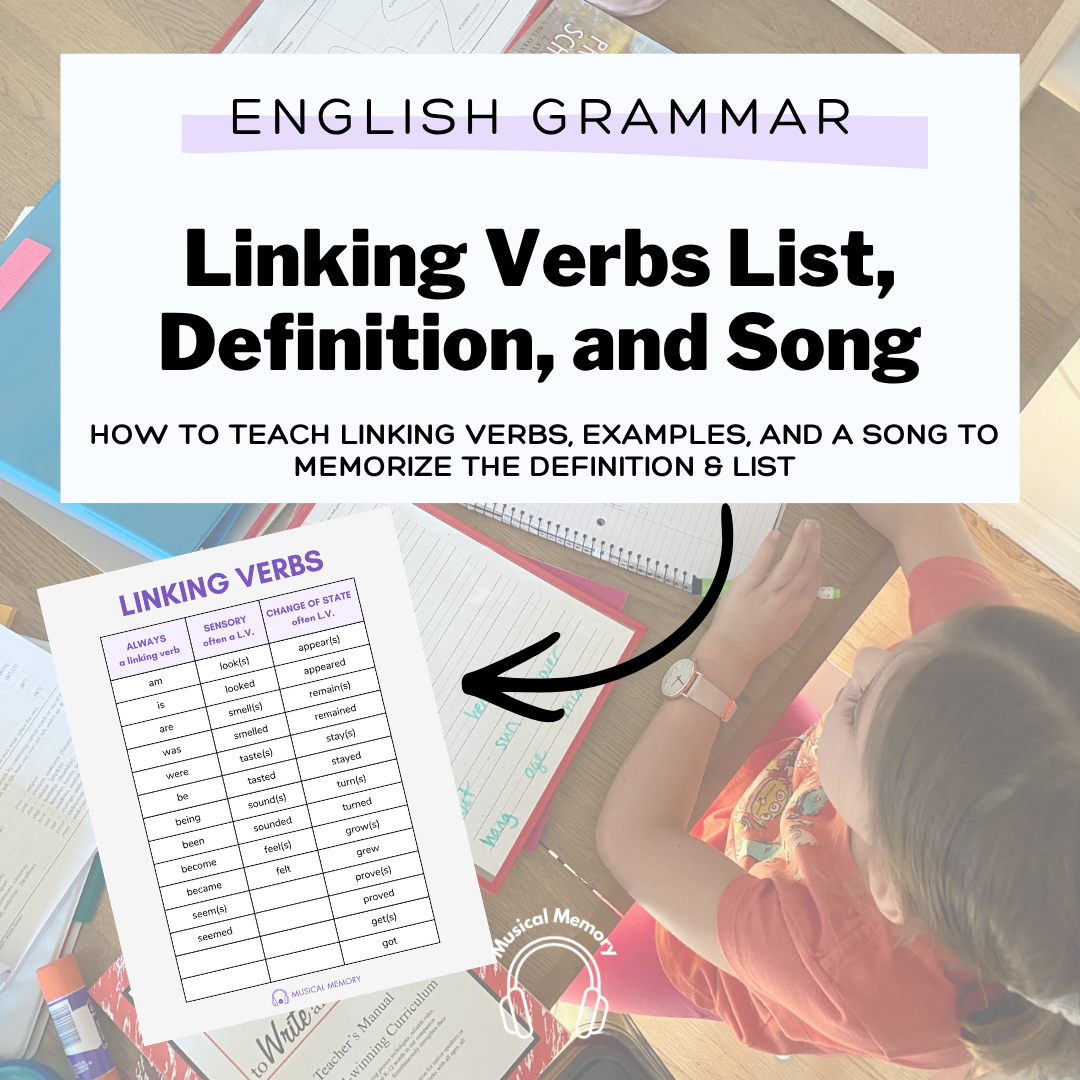
Here’s a clear linking verbs list with a song!! The song has the definition and list. The rest of this article has examples for your kids/ students (or yourself!) and further explanations of the types of linking verbs.
Linking Verbs List
Usually for young children, you’ll just teach the “always a linking verb” list first. That’s what we have a song for. It introduces the basic idea of linking verbs.
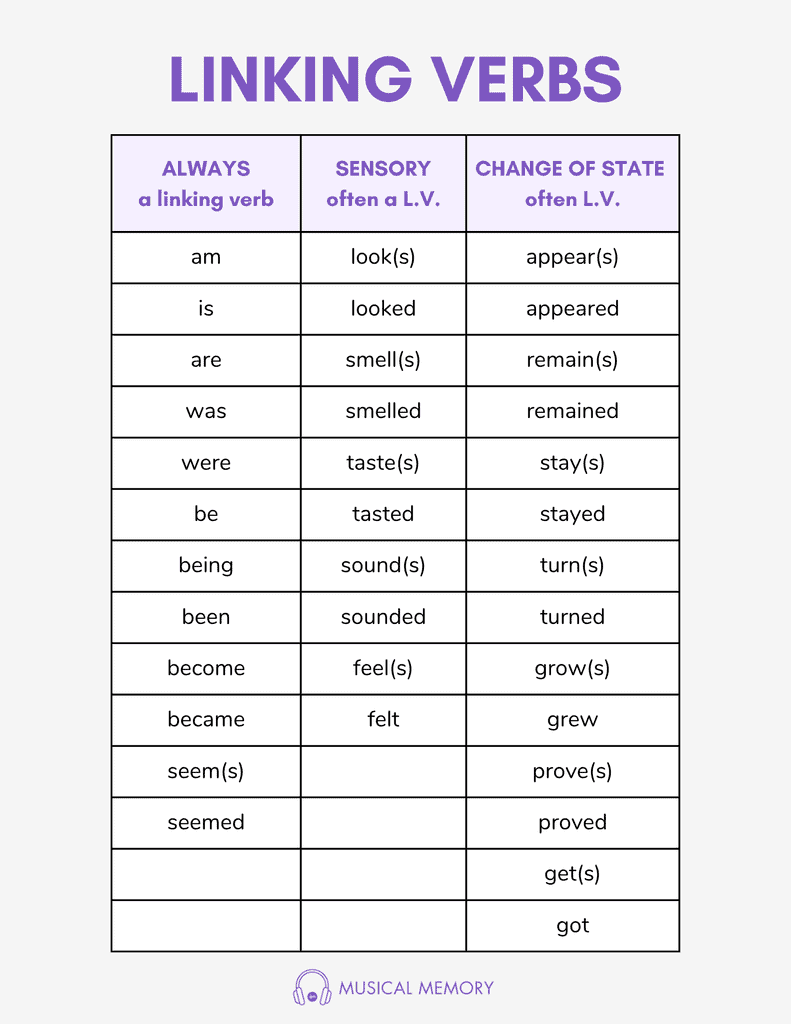
Always a linking verb (forms of be, become, seem):
am, is, are, was, were, be, being, been, become, became, seem, seems, seemed
Sensory (often linking verbs):
look, looks, looked, smell, smells, smelled, taste, tastes, tasted, sound, sounds, sounded, feel, feels, felt
Common conditionals (state / change):
appear, appears, appeared, remain, remains, remained, stay, stays, stayed, turn, turns, turned, grow, grows, grew, prove, proves, proved, get, gets, got
So, that’s your complete linking verbs list for english grammar… though sometimes those words on the sensory/ common conditionals lists are NOT linking verbs. Once you start talking about purpose of the word in the sentence, that’s very abstract & a better lesson for older kids.
For littles, I’d sing the song, read the picture books for discussion and move on. You can circle back to the concept in 5th-8th grade for more in depth grammar lessons.
Linking Verbs Song (definition & list)
Here is a short song to help your kids memorize the definition of a linking verb & the verbs that are ALWAYS linking verbs. The other types of linking verbs (sensory & conditional) are more abstract and better suited to middle school & above grammar studies.
Song lyrics (and a GREAT definition of linking verbs):
Linking verbs are verbs that connect a subject with more information about the subject.
Am, is, are, was, were, be, being, been are the most common linking verbs.
But there are many more such as become and seem and verbs related to the 5 senses.
What Linking Verbs Do
A linking verb does not show a busy action. It connects the subject of a sentence to more information about that subject. Think of it as a bridge: subject + linking verb + description or rename.
Note: Some grammar books call linking verbs copular verbs. Same idea. When you see that term on a worksheet, just know it’s synonymous with linking verb.
Examples of linking verbs in a sentence:
- The soup tastes delicious. (links soup → delicious)
- Maya is the captain. (links Maya → captain)
- They seem tired. (links they → tired)
The main verb here is the linking verb itself. It names a state, not an action or a doing.
Subject Complements: Predicate Adjective and Predicate Noun
Whatever follows a linking verb is often called a subject complement… it gives additional information about the subject.
Two kid-friendly flavors:
Predicate adjective (describes the subject):
- The cookies smell sweet. (smell = linking verb; sweet = predicate adj.)
- Our morning feels calm. (feels = LV; calm = p. adj.)
- That answer sounds right. (sounds = LV; right = p. adj.)
Predicate noun (renames the subject noun):
- Maya is the captain. (is = linking verb; captain = predicate noun)
- Ben became the helper. (became = LV; helper = p. noun)
- Those birds are robins. (are= LV; robins = p. noun)
We have a cute song for predicate noun too – it’s technically called the predicate nominative!
I tell kids the subject of the sentence stays the star. The complement just compliments the subject; it tells us more information about it.
For Older Kids: Linking Verbs vs. Action Verbs
Some of the words on the lists above can be action verbs or linking verbs depending on context. English Grammar is wild! This differentiation is really for older kids who are learning to think more abstractly about language.
For elementary students, if they can identify the basic parts of speech and the subject of the sentence, they’re likely far ahead of most kids their age!!
Action verbs show what someone does: run, eat, look (as in look at), taste (as in taste the soup on purpose), where as linking verbs connect and have more of a feeling/ being/ description type purpose.
Compare:
- She looks happy. → linking (happy describes she)
- She looks at the map. → action (she is doing the looking)
- The bread smells wonderful. → linking
- He smells the bread. → action
I give this hint to kids – it’s super helpful!! If you can swap in equals or is for the verb & the sentence still sorta makes sense, it’s probably a linking verb.
So for the above examples….
- “She equals happy” is goofy but workable.
- “She equals at the map” falls apart and makes no sense.
Linking Verbs vs Helping Verbs
Helping verbs (also called auxiliary verbs) partner with another verb to build a phrase. Linking stands alone as the main connector.
Compare:
- She is happy. → linking (is + description)
- She is running. → helping (is + main action running)
Here is our complete post about helping verbs with a song & list if you want to teach more about that.
Quick Practice and the Linking Verbs Song
Try this with these sentences. Circle the linking verb. Label the complement (ahem: the part after it that gives more information) as predicate adjective or predicate noun.
- The puppies seem playful.
- Noah is the leader.
- Dinner smells amazing.
- Those clouds look gray.
- Emma became the narrator.
Simplify Elementary School Grammar with Songs & Books
My favorite way to teach grammar concepts is my favorite way to teach everything in elementary school: songs & books. My 7th and 8th grade kiddos are “ahead” of the curve in Language Arts and were EASILY able to jump into formal grammar curriculum with applied understanding even though they never did boring grammar worksheets ad nauseam when they were little… here’s what we did for K-5 instead:
- sang songs on the weekly playlist (about english grammar and lots of other topics)
- read books – quality literature read alouds AND the grammar specific books listed below
- memorized & recited poetry
- narrations – oral retellings of what we read
- copywork based handwriting practice
- 4th grade & 6th grade – IEW 1A, 2B
- 5th – Fix it Grammar (first 2 levels) & finish SWR spelling (with copywork grammar)
- 7th/8th – student’s choice: IEW 3B (or) 1C & Fix it Combo OR The Good and The Beautiful Language Arts at grade level. The kids excelled in these programs with their various sentence labeling, diagramming, and writing requirements even though they had no grammar workbooks through elementary school.
We sing grammar songs & the I use picture books below that go with the songs to teach the concept through discussion. Our homeschool daily routine consists of Morning Time where I teach everyone together. This is when I would read a grammar picture book. Some of our favorite grammar picture book series are:
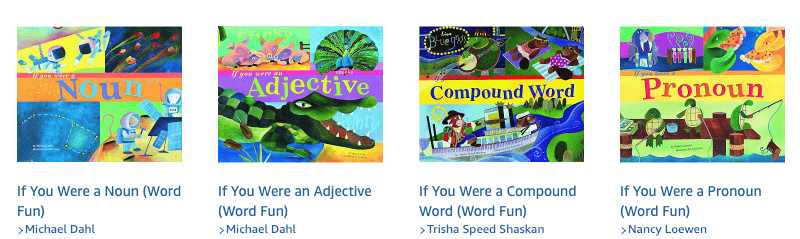
If you were a ______________. Note there are a few different authors for this series.
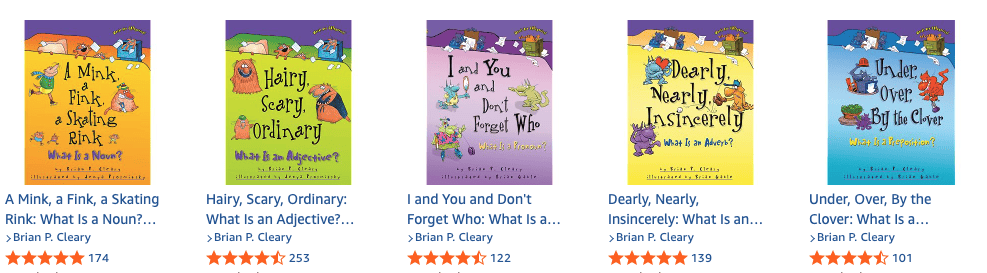
What is a ____________? (Brain P. Cleary); he has written SEVERAL grammar books that are great! I aim to read them all with my elementary school kids.
As mentioned above, when my kids are a little older ( 10-12 ish), I have them start Fix It Grammar! or IEW 1A (writing program that includes grammar instruction) or another basic grammar program where they can apply the concepts at a deeper level.
Want the full English Grammar Song Set with MP3s + a printable guide? English Grammar songs are here in the shop: English Grammar songs. Or for super easy full access, they’re all in our app where hundreds of learning songs for kids live (plus the growing library of printable resources as well).
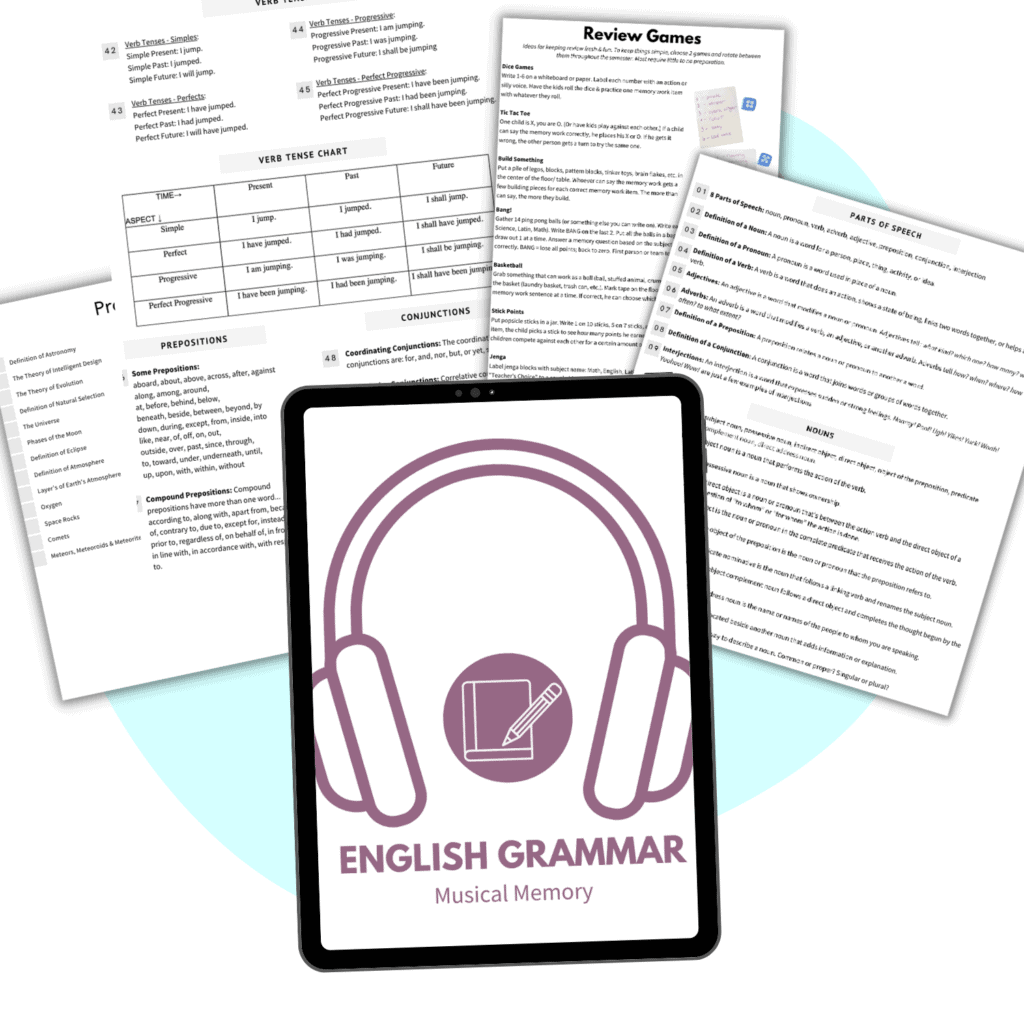
You can see the full Musical Memory scope and sequence here if you want to see how all the songs & cycles fit together.
FAQ
What is a linking verb?
A linking verb connects the subject to a subject complement. It does not show action. It renames or describes.
Is “be” always linking?
No. Is / am / are can help another verb (is running). When is stands alone with a description or rename (is happy, is the captain), it’s linking.
Linking vs helping again?
Linking = main connector to a complement. Helping / auxiliary = partner in a verb phrase with another main verb.
What grade is this for?
Usually grades 1 to 5… Younger kids can sing the list first and unpack predicate terms when they’re ready. Pair it with our homeschool curriculum picks however you like.
A Closer Look at Linking Verbs
Take a closer look at this linking verb definition: a linking verb names the state of the subject and connects it to the rest of the sentence. The most common linking verb is be, but true linking verbs also include common linking verbs such as seem, become, remain, and feel. A linking verb example is “The soup is warm.” In this example of a linking verb, is connects soup with an adjective phrase. That is an integral part of English grammar and an easy way for a native English speaker or a new learner to review different types of verbs.
Read the following sentences. In the first sentence, “Mia is cheerful,” the bolded word is is, and cheerful is an adjective phrase. In the second sentence, “Mia is singing,” is is a helping verb, not a linking verb. This second example shows why the form of the verb is not enough. Look at the rest of the sentence. A direct object usually follows transitive verbs, while an intransitive verb does not take a direct object. A prepositional phrase can follow a linking verb or an action verb, so check the job.
Linking verbs do not express actions. Action words, dynamic verbs, mental actions, and sense verbs can describe movement, thought, or perception; stative verbs and states of being describe a condition. Irregular verbs make the form of the verb change, so compare singular subjects and plural subjects. These parts of speech can seem like special predicates at first, but a few example sentences make the pattern easy. Use this verbs example with kids: social media accounts are useful, and practice is a lot of fun. Then identify the action of the verb and find another example of a linking verb.